Arrhythmia in Cats: Signs & When to Worry (Vet Verified)

Cats are remarkably good at appearing fine. It’s one of their most deeply ingrained traits, and one of the reasons heart rhythm problems so often go undetected until a routine exam, or until something more obvious forces the issue. If you’re here because a vet recently flagged an arrhythmia, you’re already a step ahead.
Here’s the reassuring truth: not all arrhythmias are dangerous. Some are benign and require no treatment at all. Others do need attention. Understanding the difference and knowing what signs to watch for in arrhythmia in cats is what this article is here to help with.
What Is Arrhythmia in Cats?
Arrhythmia in cats refers to an abnormal heart rhythm, where the heart beats too fast, too slowly, or irregularly. Causes range from stress and systemic illness to underlying heart disease. Some arrhythmias in cats are harmless, while others can be serious. Because cats rarely show obvious signs, recognizing subtle changes in activity, breathing, and behavior is key to early detection.
Key Takeaways
- Arrhythmia in cats describes any abnormality in the heart’s electrical rhythm: too fast, too slow, or irregular
- Not all arrhythmias are dangerous; some are incidental findings that require only monitoring
- Cats are skilled at concealing symptoms, meaning arrhythmias often go undetected until more advanced
- Heart disease is one cause, but arrhythmias can also result from systemic conditions such as hyperthyroidism, kidney disease, or electrolyte imbalances
- Diagnosis always requires an ECG; a stethoscope auscultation alone is often insufficient
- Continuous monitoring of heart rate, resting respiratory rate, and activity levels can help detect subtle changes before they escalate
Arrhythmia in Cats, Explained
The heart beats in response to electrical impulses generated by the sinus node (a cluster of specialized cells in the right atrium that acts as the heart’s natural pacemaker). These impulses travel through the atria, pass through the atrioventricular (AV) node, and trigger contraction of the ventricles. This coordinated sequence is what produces a normal, regular heartbeat.
Arrhythmia occurs when something disrupts this electrical system. The disruption can originate in the sinus node itself, along the conduction pathways, or in the muscle of the heart, and each location produces a different type of rhythm disturbance.
Arrhythmias are broadly classified in two ways: by their rate (tachyarrhythmias, where the heart beats too fast, or bradyarrhythmias, where it beats too slowly) and by their origin (supraventricular arrhythmias, originating in the upper chambers, or ventricular arrhythmias, originating in the lower chambers). Ventricular arrhythmias tend to carry greater clinical significance.
Importantly, an arrhythmia does not automatically mean heart disease. According to Veterinary Information Network (VIN), while heart disease can cause arrhythmias, an arrhythmia doesn’t necessarily indicate that a cat has a primary cardiac condition. Systemic illness, metabolic disturbances, and even acute stress can all produce temporary rhythm changes.
What Are the Signs of Heart Arrhythmia in Cats?
This is one of the most challenging aspects of feline arrhythmias: many cats show no obvious signs at all, particularly in milder cases. When symptoms do appear, they tend to be non-specific, the kind of changes that are easy to attribute to aging, stress, or a temporary off day.
Signs that may indicate a cardiac arrhythmia include:
- Lethargy or reduced activity — less interest in play, movement, or interaction
- Weakness or unsteadiness — particularly episodes that come and go
- Increased resting respiratory rate — more than 30/35 breaths per minute during sleep, which may indicate the heart is not pumping efficiently
- Rapid or labored breathing — visible effort with each breath
- Reduced appetite — eating less or losing interest in food
- Fainting or sudden collapse — brief episodes of loss of consciousness or muscle control
- Pale or bluish gums — indicating inadequate oxygen delivery
Some arrhythmias produce what is known as a “gallop rhythm”: a third heart sound audible during auscultation that suggests the heart is under increased stress. This is typically something a vet detects during an examination rather than something owners can identify at home.
It’s also worth noting that because cats spend a significant portion of their day sleeping, a moderate increase in rest or a slight reduction in activity can go unnoticed for weeks, which is precisely why tracking trends over time is more informative than any single observation.
“Cats often hide heart-related symptoms very well, so arrhythmias may go unnoticed until they become more serious. Monitoring changes in heart rate, activity, and resting respiratory rate can help identify subtle warning signs much earlier.” — Sara Leitão, DVM, Veterinarian at Maven Pet
What Causes Cardiac Arrhythmia in Cats?
Arrhythmias in cats have a wide range of potential causes — cardiac and non-cardiac alike. Identifying the underlying cause is central to determining how serious the arrhythmia is and how it should be managed.
Cardiac causes include:
- Hypertrophic cardiomyopathy (HCM) — the most common underlying heart condition in cats, where the thickened, stiff ventricular wall can disrupt normal electrical conduction
- Dilated cardiomyopathy (DCM) — associated with taurine deficiency, now rare due to improved commercial cat food formulations
- Restrictive cardiomyopathy (RCM)
- Congenital heart defects
Non-cardiac (systemic) causes include:
- Hyperthyroidism — excess thyroid hormone accelerates the heart rate and can cause persistent tachycardia or arrhythmias; treating hyperthyroidism often resolves the rhythm disturbance
- Chronic kidney disease — electrolyte imbalances, particularly elevated potassium (hyperkalemia), can significantly disrupt cardiac conduction
- Hypertension (high blood pressure) — can both cause and result from cardiac changes
- Electrolyte abnormalities — imbalances in potassium, sodium, or calcium affect the heart’s electrical activity
- Anaemia — reduced oxygen-carrying capacity places added strain on the heart
- Stress or acute fear — can temporarily alter heart rhythm, particularly in the clinic environment
Some breeds carry a higher genetic predisposition. Maine Coon cats and Ragdolls are more prone to HCM, while Persians and Himalayans also show elevated rates of cardiomyopathy. However, any cat of any breed, age, or sex can develop an arrhythmia.
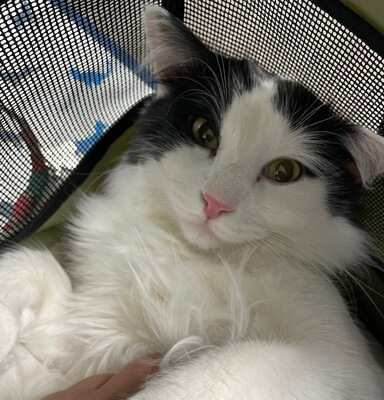
“Every time Umi is hospitalized, it’s for like four days and it costs over $5,000… Maven has helped me not only save money but also save his life”
★★★★★
Jessica Ortiz
Umi
Is Arrhythmia in Cats Serious?
The honest answer is: it depends entirely on the type of arrhythmia, its underlying cause, and how it affects the heart’s ability to pump blood effectively.
Some arrhythmias, such as sinus arrhythmia, where the heart rate fluctuates with the breathing cycle, are less frequent than in dogs but completely normal in cats and carry no clinical significance. These require no treatment.
Others can be serious. Ventricular tachycardia, for instance, where the lower chambers of the heart beat very rapidly and independently of the upper chambers, can impair blood flow to vital organs and carry a risk of sudden cardiac death if left untreated.
The key factors that determine severity are whether the arrhythmia is causing symptoms, how frequently it occurs, whether it is associated with underlying heart disease, and whether it compromises the heart’s ability to maintain adequate circulation.
This is why any newly detected arrhythmia warrants veterinary evaluation, even if the cat appears outwardly well. A diagnosis cannot be made from observation alone.
How Is Arrhythmia Diagnosed in Cats?
Detecting an arrhythmia with a stethoscope is a starting point, but a complete diagnostic picture requires more. The Cummings School of Veterinary Medicine at Tufts University notes that cats with heart disease are less likely to have a detectable murmur — meaning auscultation alone may miss significant cardiac changes.
The standard diagnostic approach includes:
- Electrocardiogram (ECG/EKG) — the essential tool for identifying and classifying arrhythmias, revealing the heart’s electrical activity in real time
- Holter monitor — a wearable device that records cardiac rhythm over 24 to 48 hours, particularly useful for intermittent arrhythmias that may not appear during a clinic visit
- Echocardiogram — ultrasound of the heart, considered the gold standard for evaluating cardiac structure and function, and the best tool for diagnosing underlying conditions like HCM
- Blood work — to assess kidney function, electrolyte levels, and thyroid hormone, given that systemic conditions are common arrhythmia triggers; a proBNP blood test can also screen for cardiac muscle stress
- Blood pressure measurement — to evaluate for hypertension
- Chest X-rays — to check for cardiac enlargement, fluid accumulation, or changes in the pulmonary vasculature
In some cases, a referral to a veterinary cardiologist is recommended to guide diagnosis and treatment planning.
How Is Arrhythmia Managed?
Management of arrhythmia in cats is always guided by the underlying cause and the clinical significance of the rhythm disturbance. There is no single treatment approach.
- Treating the underlying condition is often the first step. When an arrhythmia is secondary to hyperthyroidism, kidney disease, or an electrolyte imbalance, correcting that condition frequently resolves or substantially improves the rhythm abnormality
- Anti-arrhythmic medications may be prescribed when the arrhythmia itself requires direct management, particularly when it is causing symptoms or carries a risk of deterioration
- Diuretics may be needed if fluid has accumulated in or around the lungs as a consequence of reduced cardiac output
- Activity restriction is commonly recommended, either temporarily or long-term, depending on the severity of the arrhythmia and the degree of cardiac compromise
- Pacemaker implantation is reserved for severe cases, particularly those involving high-degree AV block or sick sinus syndrome, where the heart’s natural pacing mechanism has failed
- Regular recheck examinations are a standard part of long-term management. Repeat ECGs, blood work, and echocardiograms allow the veterinary team to track disease progression and adjust treatment as needed
How Maven Helps
Arrhythmias in cats are often silent, which means the window between a normal-looking cat and a cat in cardiac distress can be narrower than owners realize. The most valuable thing continuous monitoring can offer in this context is not diagnosis (which always requires clinical investigation), but early awareness: the recognition that something has shifted before it becomes obvious.

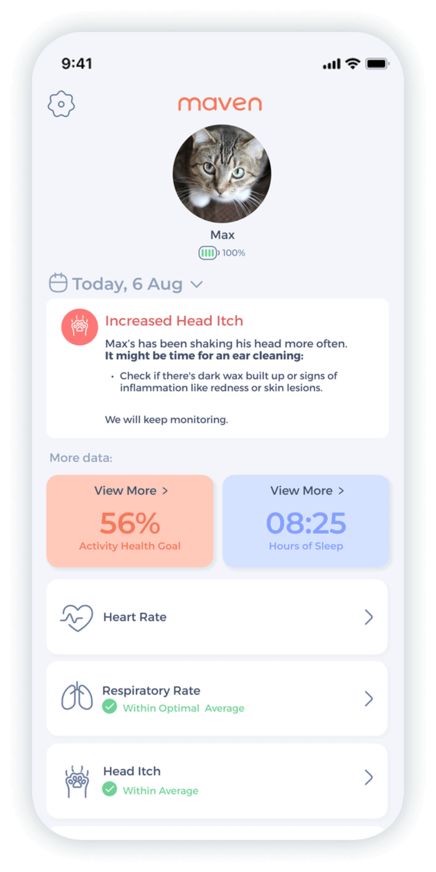
Monitor heart rate, respiratory rate, activity & rest, itch behavior.
The Maven Pet Health Monitor supports this through consistent, at-home tracking:
- Tracks resting heart rate, capturing changes in resting heart rate over time that may reflect evolving cardiovascular stress, enabling owners and vets to identify meaningful trends
- Monitors resting respiratory rate, which can rise as the heart works harder to compensate
- Measures activity levels, identifying reductions in daily movement or sustained lethargy that may precede more obvious symptoms
- Tracks rest patterns, detecting increases in sleep duration or changes in resting behavior that may reflect fatigue or reduced cardiac output
- Builds a personalized baseline for each cat, so that deviations are flagged against what is genuinely normal for them
- Sends alerts when deviations occur, such as a rising resting respiratory rate or a sustained shift in heart rate or activity patterns
This continuous picture gives owners something a periodic vet visit cannot: a reliable record of how the cat is doing between appointments, at rest, in their home environment.
FAQ (Vet-Reviewed)
Arrhythmia in cats is an abnormality in the heart’s electrical rhythm, causing it to beat too fast, too slowly, or irregularly. It can originate in different parts of the heart’s conduction system and ranges from benign incidental findings to serious conditions requiring treatment.
Causes include primary heart diseases such as hypertrophic cardiomyopathy, as well as systemic conditions like hyperthyroidism, kidney disease, electrolyte imbalances, and hypertension. In some cases, no identifiable cause is found.
Many cats show no symptoms. When signs do appear, they may include lethargy, weakness, reduced appetite, increased resting respiratory rate, rapid or labored breathing, and, in more serious cases, fainting or collapse. Because these signs are non-specific and develop gradually, they are often missed until the arrhythmia has progressed.
Some arrhythmias are benign and require no treatment. Others — particularly ventricular tachycardia, high-degree AV block, or arrhythmias secondary to significant heart disease — can be serious and require prompt management. The severity depends on the type, frequency, and underlying cause of the arrhythmia, which is why veterinary evaluation is always recommended.
Treatment depends on the type and cause of the arrhythmia. Addressing an underlying condition, such as hyperthyroidism or kidney disease, often resolves the rhythm abnormality. When the arrhythmia itself requires treatment, options include anti-arrhythmic medications, diuretics for associated fluid accumulation, activity restriction, and in severe cases, pacemaker implantation.
Conclusion
Arrhythmia in cats covers a broad spectrum, from normal physiological variation to conditions that require urgent care. What makes it particularly challenging is that cats are so effective at concealing the early signs, and the clinical tools available in a standard consultation don’t always catch intermittent rhythm changes.
That’s why the combination of regular veterinary monitoring and consistent at-home tracking matters. It is what makes it easier to notice when something shifts, and to bring that information to your vet before it becomes a crisis.
Maven Pet focuses on improving the quality of life of our pets with technology, using artificial intelligence (AI) to enable proactive pet care. By accurately collecting and monitoring pet data 24/7 and flagging any irregularities, Maven Pet empowers pet parents and veterinarians to stay ahead of potential health issues, ensuring the well-being and longevity of our beloved companions.